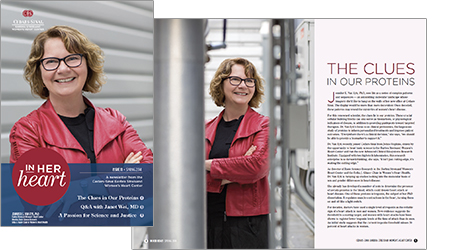
The Clues in Our Proteins
Jennifer E. Van Eyk, PhD, sees life as a series of complex patterns and sequences — an astonishing molecular landscape whose imagery she'd like to hang on the walls of her new office at Cedars-Sinai. The display would be more than mere decoration: Once decoded, these patterns may reveal the mysteries of women's heart disease.
For this renowned scientist, the clues lie in our proteins. These crucial cellular building blocks can also serve as biomarkers, or physiological indicators of disease, in addition to providing guideposts toward targeted therapies. Dr. Van Eyk's focus is on clinical proteomics, the large-scale study of proteins to inform personalized treatments and improve patient outcomes. "Everywhere there's a clinical decision," she says, "we should be able to provide
a biomarker to support it."
Dr. Van Eyk recently joined Cedars-Sinai from Johns Hopkins, drawn by the opportunity to head basic science in the Barbra Streisand Women's Heart Center and run the new Advanced Clinical Biosystems Research Institute. Equipped with two high-tech laboratories, this research enterprise is so forward-thinking, she says, "it isn't just cutting-edge, it's making the cutting edge."
As director of Basic Science Research in the Barbra Streisand Women's Heart Center and the Erika J. Glazer Chair in Women's Heart Health, Dr. Van Eyk is ramping up studies looking into the molecular basis of sex and gender differences in heart disease.She already has developed a number of tests to determine the presence of certain proteins in the blood, which could denote heart attack or heart disease. One of these proteins is troponin, the subject of her PhD dissertation.
A Passion for Science & Justice
Growing up in Los Angeles, Erika Glazer used to spend every weekend at the beach, swimming or surging -- a typical outdoorsy, active teenager.
Then came an eight-month internship at age 16, during which she sat for long hours inside a cardiology lab at Cedars of Lebanon. Although it might have cut down on her time in the sun, the experience proved transformative for the self-described science-and-math geek. "I remember one of our projects involved a pediatric incubator for babies forn with heart defects. It was so exciting to be there," she recalls. "I was in my element."
Today, despite the demands of being one of L.A.'s most dedicated philanthropists, a highly successful real estate and equities investor, and co-owner of the NBA's Golden State Warrios, Glazer still geeks out on math and science. She becomes visibly energized when asked to talk about the highly complex field of proteomics and the research of Jennifer E. Van Eyk, PhD. "I guess I'm a frustrated physician," Glazer says. |